Language

2026/10/13 Report
From September 6 to 15, 2026, a short-term study program was held in the Republic of Uzbekistan as part of International Lectures in Education: “Education and Culture in Central Asia.” The program brought together Professor Shirozu, Research Fellow Ulzii, and six students from the Faculty of Education. The program aimed to provide students with a comprehensive understanding of contemporary society, culture, and education in Uzbekistan through university visits, educational exchanges, and field trips to historical and cultural heritage sites in Central Asia. Through interactions with local students, faculty members, and residents, the program also sought to deepen intercultural understanding, broaden students’ international perspectives, foster an active approach to learning, and encourage an interest in studying abroad and international collaboration. This program was conducted with support from the Multicultural Campus Project Toward Social Impact through Hokkaido University’s “Global Education for Well-being Society: HOKUDAI International Co-creation Project.”
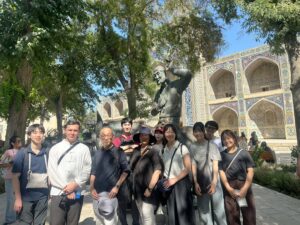
From September 6 to 15, 2026, six students from the Faculty of Education participated in a short-term study program in the Republic of Uzbekistan, entitled “International Lectures in Education: Education and Culture in Central Asia.” Traveling from the capital, Tashkent, to Samarkand, Shakhrisabz, and Bukhara, the students visited educational institutions and conducted fieldwork on the history and culture of Central Asia.
Visits to Four Pedagogical Higher Education Institutions
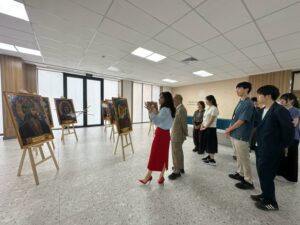
During the program, we visited four teacher training higher education institutions: National Pedagogical University of Uzbekistan named after Nizami in Tashkent, Samarkand State Pedagogical Institute, Shahrisabz State Pedagogical Institute, and Bukhara State Pedagogical Institute. At each institution, we learned about its educational and research activities and teacher education programs, toured the campus and facilities, and interacted with faculty members and students.
We are particularly grateful to Dilnoza Kholmurodova, Vice-Rector for International Cooperation at National Pedagogical University of Uzbekistan, who coordinated the entire program from the planning stage, including our visits to universities and educational institutions in each city. The successful completion of this extensive program, which involved traveling considerable distances, would not have been possible without her tremendous efforts and the generous support of everyone involved.
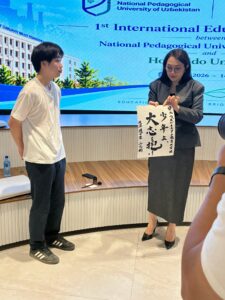
On the final day of the program, we returned to National Pedagogical University of Uzbekistan to report on what we had learned and experienced during our stay. On this occasion, Rector Hilola Umarova presented certificates of completion to the participating students. We would once again like to express our sincere gratitude to the rectors, faculty and staff members, and students of all four institutions for their warm welcome and generous support.
Exploring Educational Settings and Historic Cities
In each city, our visits to pedagogical higher education institutions were complemented by visits to other educational institutions and historic sites.
In Tashkent, in addition to visiting National Pedagogical University of Uzbekistan named after Nizami, we visited a kindergarten, where we learned about educational practices that respect children’s voices as well as a system of teacher education that combines academic studies with practical experience in schools and kindergartens. We also visited the Center of Islamic Civilization, Hazrati Imam Square, Chorsu Bazaar, and other sites, deepening our understanding of Uzbekistan’s history and society from ancient times to the present.
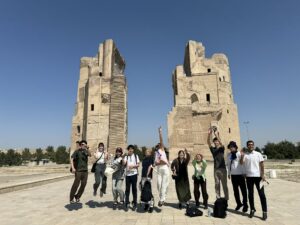
In Samarkand, in addition to our exchange at Samarkand State Pedagogical Institute, we observed a Japanese-language class at a high school. Meeting high school students studying Japanese in Central Asia, far from Japan, was a particularly memorable experience for our students. At Registan Square, the Gur-e-Amir Mausoleum, the Shah-i-Zinda complex, the Ulugh Beg Observatory, and other historic sites, we encountered the scholarly, educational, and architectural culture that flourished during the Timurid period.
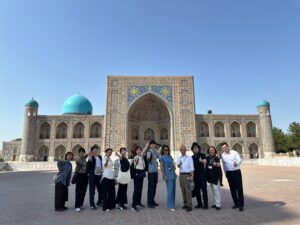
In Shakhrisabz, we toured the facilities of Shahrisabz State Pedagogical Institute and visited historic sites associated with Amir Timur, including the remains of Ak-Saray Palace. In Bukhara, in addition to visiting Bukhara State Pedagogical Institute, we explored the historic district, including the Ark, the Kalyan Mosque, madrasas, and bazaars. These visits provided an opportunity to consider how religion, education, commerce, and everyday life have historically been interconnected in the cities of the Silk Road.
Reflecting on Education, History, and Culture through First-Hand Experience
At the end of each day, the participating students prepared field notes documenting their impressions, comparing their observations with their experiences in Japan, and reflecting on questions raised by their experiences during the program.
With regard to education, several students focused on the close integration of academic studies and practical experience in educational settings within Uzbekistan’s teacher education system and reflected on how this approach differs from teacher education in Japan. Their first-hand observations—including the large number of women working in education, the emphasis on children’s voices in early childhood education, and the role of arts education at universities—also prompted them to think more deeply about the relationship between education, society, and culture.
The students interest in history and culture also extended beyond simply visiting historic sites. They reflected on the advanced astronomical research conducted at the Ulugh Beg Observatory, the scholarly culture centered on madrasas, the relationship between Islam and everyday life, and changes in historical interpretations of Amir Timur. Their field notes included reflections on how the way we view history can differ depending on who tells the story, as well as on the importance of understanding religion and culture not through one-dimensional images but from the perspectives of people living within those societies.
Through interactions with local students, our students also gained insights into aspects of society that differ from those in Japan, including students’ enthusiasm for learning multiple languages, the culture of welcoming guests with music, dance, tea, and sweets, and different attitudes toward family and everyday life. The experience of asking questions, listening to others, and expressing their own thoughts across linguistic and cultural differences was itself an important part of their learning.
This program offered students not only opportunities to learn about education at universities and schools but also an extensive fieldwork experience as they traveled from Tashkent to Samarkand, Shakhrisabz, and Bukhara, exploring the cities, historic sites, educational institutions, and interacting with local people. Through these experiences, they were able to consider education in relation to the history, culture, religion, and everyday life of society.
We would like to express our deepest gratitude to National Pedagogical University of Uzbekistan named after Nizami, Samarkand State Pedagogical Institute, Shahrisabz State Pedagogical Institute, and Bukhara State Pedagogical Institute, as well as to everyone at the institutions we visited, for their generous support and warm hospitality throughout the program.